Nothing Phone 4a Pro Review

Nothing Phone 4a Pro pros and cons
Premium aluminium design.
Impressive AMOLED display with 144Hz refresh rate.
Strong camera credentials, with telephoto lens.
Fantastic value for money.
No wireless charging.
140x digital AI zoom delivers mixed results.
With a proficient periscope zoom lens, super-bright yet silky display and a refined user interface, the Nothing Phone 4a Pro is in its element disrupting the smartphone status quo and redefining what to expect from a mid-range device.
Check out our Nothing Phone 4a Pro review to see whether a new Glyph Matrix design and sharp looks are a rare case of both style and substance.

Design and specifications
A personal affection for London-based independent device manufacturer Nothing stems entirely from an appreciation of their taking cues from the world of fashion: bleeding-edge cool, bold aesthetics and (seemingly) effortless brand cachet.
The Phone 4a Pro is entirely cut from this cloth, boasting a confident shift from their transparent looks of earlier devices headlong into brutalist noughties metal minimalism.
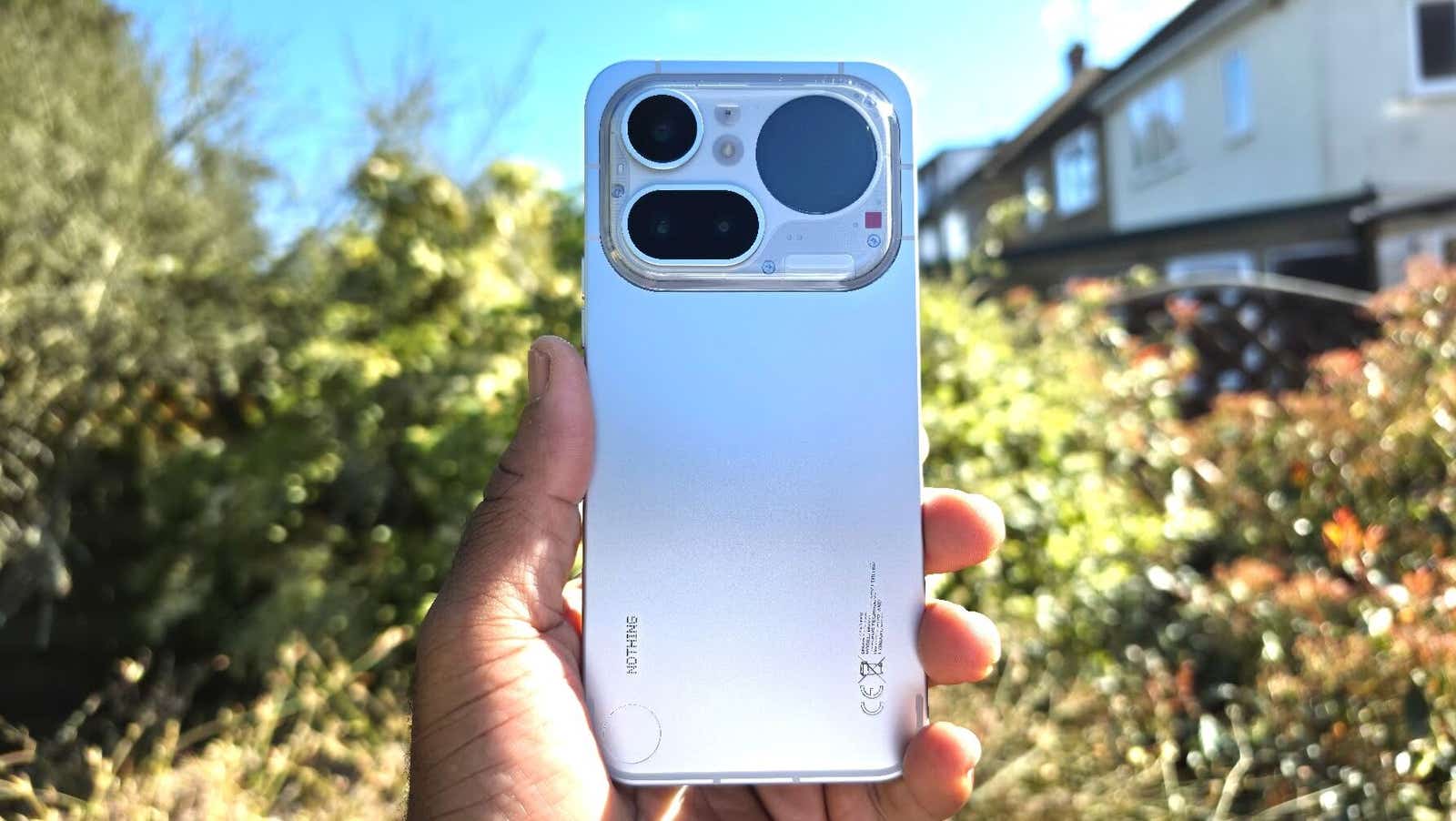
With a sleek, curvaceous aluminium unibody design that sits comfortably in the palm, it measures 163.6 by 76.6 by 7.95mm and weighs a not-insubstantial 210g.
Every gram of heft feels deliberate, however, eschewing any sense of compromise in what by all accounts is a mid-range device on paper.
The 4a Pro’s build quality is excellent, replacing the mixture of polycarbonate and glass of older models with a dense metal frame that feels decidedly premium, despite the asking price.
That sense of durability and sturdiness isn’t just for show. It features an IP65 certification ensuring survival against accidental drops into the sink and dusty environments, while Corning Gorilla Glass 7i on the front offers protection from screen scuffs and scrapes.
Those looking for that bit of added safety will find a transparent phone case in the box.
Nothing has also updated its colour palette for this release, available in a classic Black, an elegant Silver (which we reviewed) and an eye-catching Pink.

The Silver model captures the light beautifully and manages to look sophisticated. It does a brilliant job of highlighting the signature rear, even if it is slightly more prone to fingerprints than the darker option.
If prior devices evoked Frutiger Aero tinged nostalgia for colourful iMacs, translucent textures and pedal-pushers, the 4a Pro elevates Nothing into Dieter Rams territory with deliberate utilitarianism.
That being said, Nothing’s signature transparency is still present, although now confined strictly to a raised camera island, creating a gorgeous contrast with the opaque metal frame.
This contoured camera bump is entirely ‘this season’ given the iPhone 17 Pro Max's pervasive influence. It mirrors the shape of Nothing’s own lauded Headphone (1), presenting a confident and cohesive brand identity which many manufacturers would kill for.
It is also a little pared-back versus the avant-garde stylings of the Nothing Phone 3 (review here), a device we loved but recognised just how unique it was.
The 4a Pro remains cool without trying too hard, an art in and of itself.
Arriving in two memory and storage configurations (8GB of RAM paired with 128GB, or 12GB and 256GB) in two of its three hues, the pink model is only available in the upper memory bracket - meaning a bit more of an outlay for arguably its most attractive variant.

Support for eSIMs is welcome, as well as Bluetooth 5.4 and up to Wi-Fi 6. This is not the latest standard, but it still allows for swift downloads and is entirely competent for a modern mobile.
A trio of body-coloured gunmetal buttons serve as power and volume rocker on the right side of the 4a Pro. The left is punctuated by a single glossy key at odds with the burnished frame. This button allows you to launch the camera shutter on a single press, while giving easy access to the Essential Space on a double-click (more on this later).
The (Glyph) Matrix Reloaded

The signature Glyph Matrix lighting array has seen a massive overhaul for this premium tier. As such, it means a break from tradition for us as it gets its own dedicated spotlight in the review!
Comprising 137 individual mini-LEDs, this circular arrangement hits a blistering 3,000 nits of peak brightness and allows for all manner of instant visual alerts and quirky imagery.
This stands in stark contrast to the standard Phone 4a, which features a much simpler three-strip design and peaks at a modest 1,000 nits. This shows that they’re certainly not done with another of Nothing’s stand-out features.
The Pro model allows for far more granular control. It can be utilised for everything from a rear clock to a countdown timer, as well as a powerful makeshift ring light for photography or taking selfies with the main camera (something lost from the standard model’s facelift).
Nothing has also expanded the real-world utility of the Glyph Matrix with features like Glyph Progress, which allows you to track the arrival time of an Uber or count down to the next Google Calendar meeting without ever waking the screen.
Having this advanced Glyph array provides a much more interactive and customisable experience, further separating the Pro from its entry-level sibling and straying ever further from frivolous to functional with each iteration.
Display and audio

The 6.83-inch flexible AMOLED display is vibrant, sharp and fantastic for media consumption. With a 144Hz adaptive refresh rate and a staggering peak brightness of 5,000 nits (although we’re talking more like 800 nits of typical brightness), it remains fairly legible outdoors.
With a resolution of 1280 x 2800 and 450 pixels per inch, images are crisp on the 10-bit colour depth display.
A point to note is that the Gorilla Glass 7i panel can be slightly reflective under direct sunlight, thanks in part to a stock screen protector pre-applied out of the box. The auto-brightness algorithm in the current software build can be a little temperamental to compensate for changeable lighting conditions.
Eye comfort is nonetheless a priority here, as the 4a Pro’s panel is equipped with high PWM dimming to reduce strain during extended use, particularly when prodding and scrolling late into the night.

Gamers will be particularly pleased with the inclusion of a 2,500Hz touch sampling rate, ensuring inputs are registered with lightning-fast precision during competitive matches.
On the topic of touch, there is also a rapid under-display fingerprint sensor for all security needs, coupled with a fairly unimposing pinhole for the front-facing camera.
Content on the 4a Pro looks vibrant and lifelike, while the dual stereo speakers flanking the display produce a surprisingly full-bodied sound that supports the cinematic visuals perfectly.
A proficient set-up by all accounts.
Camera capabilities

Nothing knows photography is essential, so it has equipped the 4a Pro with its most ambitious imaging setup yet for a mid-range device in its range.
While a triple-lens arrangement is relatively standard fare, the underlying hardware includes a massive upgrade that fundamentally changes shooting at a distance: a novel 50-megapixel periscope telephoto camera.
This lens packs an advanced tetraprism system behind it. It blends optical image stabilisation and 3.5x optical zoom to immediately grapple with the biggest problem with mid-range zooms. This delivers sterling performance by minimising light loss.
In capturing more light and detail, it ensures that daytime portraits and zoomed shots of architecture remain sharp and noise-free, as well as delivering decent low-light images.

The high base resolution also allows for finessing for digital cropping with up to a 7x in-sensor zoom.
With an array of versatile zoom levels, the Phone 4a Pro can resolve fine detail that other phones in this price range would smooth out entirely.
This Sony LYT-700C effort houses a large 1/1.56-inch sensor and captures images with great dynamic range and natural colour reproduction.
Capturing 50-megapixel shots can only be done in 4:3. However, the stock 12-megapixel quality spans the full gamut of 16:9 to full-frame capture. This is achieved through pixel binning, which combines data from adjacent pixels to create brighter, more manageable files for everyday shooting.


Video offers a handy selection of settings, from 4K at 30fps in Ultra XDR to 1080p at up to 60fps, plus slow motion at 120fps and time-lapse photography at up to 4K.
Around the front, a 32-megapixel selfie camera boasting a 89-degree FoV and f/2.2 aperture handles video calls and portraits with ease, delivering sharp results in a variety of lighting conditions.
Using refined computational photography, this system allows for capturing authentic shots without heavy-handed artificial sharpening.


The Night Mode merges seven individual frames seamlessly into one, giving a consistently balanced exposure across the entire scene without needing complex editing software later.
Efforts to capture consistently at 7x zoom did get a little ‘swimmy’ when trying to snap distant architecture, with the image juddering on occasion.
Stabilisation is solid across the primary lenses, which effectively means the camera is far better at compensating for the natural shakes from holding the device.
This is crucial for the touted world’s first 140x zoom feature, keeping the viewfinder steady.
One particular extreme zoom test made for some interesting images, but the processing at 140x magnification (bolstered by AI enhancement) often failed to deliver the greatest shots. Judicious use of zoom levels became necessary to ensure the photo turns out as intended.
Portrait mode was also a little challenging, especially with particularly fidgety subjects.


Check out the latest mobile phone deals on Uswitch


Trying to capture some shots of my kids meant that the second-or-so of processing between pressing the shutter was enough to miss the odd fleeting moment. It is the smallest of lag, but enough to miss on occasion.
Once again, bearing in mind that this is a device that costs a fraction of fully-fledged snapping smartphones, it’s an impressive showing for the Nothing Phone 4a Pro in the image capture stakes.


Performance and software
Powering the Nothing 4a Pro is the Qualcomm Snapdragon 7 Gen 4 chipset - paring back on cost, but not at the expense of horsepower.
This chip delivers excellent speeds and introduces improved thermal management to boost gaming performance. A dedicated mode to boost efforts appears when firing up relevant apps.
Backed by up to 12GB of LPDDR5X RAM and fast UFS 3.1 storage, the phone handles both multitasking and demanding games well. Wuthering Waves was a fairly steady 30fps in Quality Mode, which was a welcome surprise.
Nothing has also included its largest ever cooling system alongside a vapour chamber, ensuring the back panel remains cool even under sustained loads.
The device runs on Android 16 with Nothing OS 4.1. This interface features a distinctive monochromatic dot-matrix visual style and a brilliantly bloat-free experience, retaining only essential applications like their long-standing voice recorder and gallery alongside Google’s own default apps.
Crucially, Nothing has committed to three years of major Android OS upgrades and six years of security patches. This is a fairly decent lifespan for a mid-range mobile.
Intelligence is central to the experience. By utilising the Essential Space AI, the phone offers intuitive assistance for daily tasks.
Features like Flip-to-Record allow you to seamlessly capture meeting audio by simply placing the phone face down and long-pressing a button, followed by receiving a full transcription afterwards.
The repositioned glossy Essential Key gives quick access to AI tools directly from the left side of the handset. This is a welcome shift away from the power button, reducing the chance of accidental presses.

Furthermore, Nothing has integrated clever sensor-based interactions. A simple Shake to Dismiss gesture silences alarms when the phone is face down, and a slight tilt of the device on a desk cycles the Matrix display between active timers and clocks. These are more human touches that belie the 4a Pro’s edgy exterior and remind of Nothing’s thoughtfulness and attention to detail.
Battery life and charging
Stamina is a standout feature thanks to efficient hardware management via Nothing OS and a generous battery capacity.
The UK model of the 4a Pro is home to a substantial 5,080mAh battery that easily powers through a full day of heavy creative work, often stretching well into a second.
There's no charger in the box, as is quickly becoming the norm, so it's BYOC (bring-your-own-charger) for this device.
Having tested the battery life during a lengthy commute, a day of work and a demanding gaming session on Wuthering Waves on the way home, the efficiency is a noticeable upgrade - making the Phone 4a Pro an easy recommendation for power users on a budget.
When the need to recharge arises, the 50W wired fast charging delivers a rapid refill at just the right speed to keep you going.
One gap keenly felt is the absence of wireless charging from the 4a Pro, however a reliance on the battery capacity (despite being less than that available further afield - buyers in India enjoy a healthy 5,400mAh effort) and flexible fast wired charging does severely reduce range anxiety.

Nothing Phone 4a Pro UK pricing and availability
The Nothing Phone 4a Pro launched in the UK in March 2026, arriving at a remarkably aggressive price point of just £499 for the 8GB RAM and 128GB of storage variant, available from the Nothing site as well as multiple UK retailers such as Very.
The 12GB and 256GB storage model is a mere £599, making for phenomenal value for the hardware and looks on offer, and potentially one of the strongest value propositions on the market today.
A premium aircraft-grade aluminium build smartphone and a proficient periscope zoom lens for under £500 is incredibly rare, making the cost of entry fiercely competitive.
Add in a launch incentive which bundles in a free pair of Nothing’s well-reviewed Ear 3 noise-cancelling earbuds worth £149 when purchasing direct until the 5th of April, and it becomes a deal which is tough to ignore.

Final verdict
The Nothing Phone 4a Pro has really established itself as a top-tier contender in the newly forged ‘mid-premium’ smartphone market.
With its class-leading periscope telephoto camera, monumental battery life and brilliant 144Hz display, it delivers a genuinely premium experience for cost-conscious and fashion-conscious fans of tech.
The design is distinctive without being divisive, the performance is great, and the Essential Space AI integration feels genuinely helpful rather than gimmicky over time.
The software experience is clean, and when considering an exceptionally competitive sub-£500 starting price, the Nothing 4a Pro stands out as a compelling choice for anyone seeking excellent mobile technology on a sensible budget.
For those who want a phone that’s big on value and looks every bit the part whilst doing so, Nothing’s Phone 4a Pro is a superb option.
