Motorola Razr 60 Ultra Review

Motorola Razr 60 Ultra pros and cons
Stylish, premium smartphone with Pantone-approved colourways.
Powerful foldable form, with fully functional external screen.
Moto AI features are approachable and additive.
Tall 22:9 display ratio can feel awkward for landscape content.
Firmly premium price point.
AI hand-holding can be a tad overbearing.
The Motorola Razr 60 Ultra arrives to prove that foldables are no longer futuristic experiments. We’re coming up to a decade since the return of the flip phone, and they’ve evolved from fragile curios to a practical and polished category.
This one however, cleverly channels the nostalgia of the original Motorola Razr’s clamshell form factor, marries it with top-tier performance and wraps it all in a beautifully engineered shell.
From an expansive inner display to the highly capable cover screen and clever - albeit eager - AI smarts, this phone feels modern, fun and genuinely novel.
Find out what we think in this Motorola Razr 60 Ultra review!

Design and specifications
Whether folded or open, the Razr 60 Ultra feels every inch a flagship, despite its stature. Motorola has crafted a phone that balances practicality with a sense of occasion.
Materials are carefully considered, with Gorilla Glass Ceramic on the front, a mix of finishes on the rear depending on colour, and an aluminium frame around the edge.
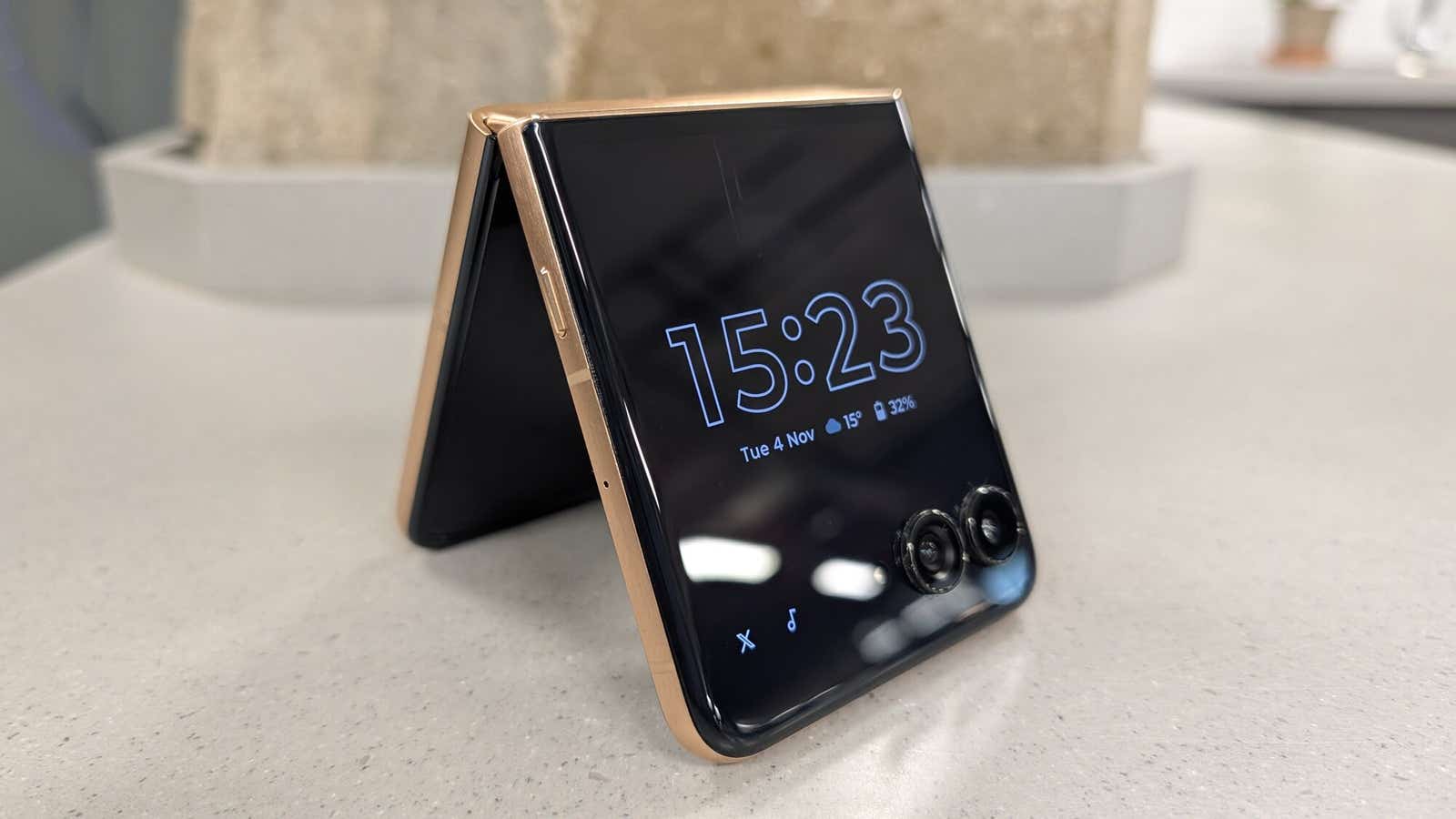
The model tested here - in Pantone Mountain Trail - comes finished in genuine FSC-certified (sustainably sourced) wood with a tactile, natural feel.
The colouring is deep and warm, offset with burnished bronze metallic accents that give the phone a refined, outdoorsy character.
A trio of alternative colour variants are Scarab - a dusky hue with a grainy finish crafted to inspire Alcantara leather, Cabaret - a pulsating pink with a satin finish, and Rio Red - a deep wine-coloured option lending an altogether more muted coda to proceedings.
All bold, all certified by the famed colour-matching institution that is Pantone, and all choices in line with the Razr 60 Ultra’s vivacious and youthful energy.
The power button - which is also where the fingerprint reader resides - sits on the right side of the device for easy access, just above a pair of distinct volume keys.
The near-customary customisable AI Key for launching voice assistants, Gemini or other shortcuts is on the opposing side of the screen, making everything within easy reach for one-handed use.
When closed, the 60 Ultra measures a mere 88.12 x 73.99 x 15.69 mm, making for a refreshingly portable smartphone - a real boon in this era of 6.7-inch displays and a proliferation of camera bars.

The simple action of using it in this smaller, squared-off state does draw stares in public, just because it’s uncommon to see a fully-fledged smartphone so neatly packaged. Thanks to developments in that front display over previous iterations, I’m glad to say that functionality is barely compromised when using the Razr fully closed, but more on this later…
At 199 grams, the Razr is solid but entirely slight, folding completely flat thanks to Motorola’s teardrop hinge and feels pocketable in a way few other smartphones manage. when unfolded, the display stretches over 171mm, giving you acres of vertical real estate for scrolling and reading.

The folding mechanism itself is firm and smooth - the all-important feel of physically shutting the device is crisp and reassuring yet authoritative, but also holds rigid at various angles for hands-free use.
Internally, the Razr 60 Ultra is powered by the Snapdragon 8 Elite Mobile Platform, paired with an Adreno GPU and Hexagon NPU for AI tasks - meaning that this diminutive handset has cut few corners when it comes to specs.
There is 16GB of LPDDR5X RAM and 512GB of UFS 4.0 storage, another vital statistic on par with the finest, whilst connectivity is present and correct for modern modems including 5G support, Wi-Fi 7 compatibility, as well as Bluetooth 5.4 for wireless cans and USB-C on its base for wired charging.
Water resistance is an altogether serviceable IP48 rating, lending protection from splashes and short submersion - not easy for a foldable.
Display(s) and audio

The main display is a 7.0-inch LTPO pOLED panel with a 2992 x 1224 resolution and 22:9 aspect ratio. It is expansive in every sense.
If you're looking for a crease-free foldable display, the Razr 60 Ultra's far from the best example of it - the indentation across the middle is somewhat prominent in direct sunlight and indoors alike, but isn't too much of a distraction.
Browsing, split-screen apps and vertical content look superb. You can read more, swipe further, and multitask better than on a traditional candybar phone.
The downside is when you turn it on its side, however. Films and games can feel oddly framed on occasion, with sizeable black bars flanking the sides due to the taller format.
As mentioned, the height does work wonderfully when viewing traditional webpages or content, but woe betide you if anything major needs to be handled in landscape…


The keyboard (thankfully split across the screen as you’d find on book-style foldables to accommodate the resulting width) occupies vast swathes of both the horizontal and vertical viewing aspect, leaving very little room to see what’s going on!
The display supports up to 165Hz refresh rate, HDR10+, Dolby Vision and 10-bit colour with 120 percent DCI-P3 coverage. Touch response hits 300Hz in game mode and brightness peaks at 4500 nits. It is one of the best panels Motorola has produced - vivid, fast and easy to use in bright sunlight.
A fairly prominent lip protruding around the entirety of the inner screen does bear mention, it’s naturally there for a protective element against both spirited snapping shut and from the elements, but is quite noticeable due to the amount you need to swipe and prod the edges of Android, particularly in ‘gesture’ mode.
Nothing to detract from the experience, but ensuring your actions are picked up does take a little getting used to.

Close the Razr 60 Ultra and you’re no longer left staring at a tiny clock face or a basic notification ticker (unless you want to).
The outer display is now a full-blown second interface - a 4.0-inch pOLED panel also running at up to 165 Hz, with a crisp 1272 × 1080 resolution and support for HDR10+ and 10-bit colour, peaking at 3000 nits.
It’s large enough to browse, type, navigate and even watch content on. You can choose which apps ‘graduate’ to live entirely on the cover display via Settings > External Display > App Settings, letting you lock them there so they stay active when the phone is closed, as well as live in a dedicated app drawer.
Whether that’s YouTube, Spotify, Google Maps, or even Chrome, you can run them natively on the outer screen without unfolding the handset. The layout has been elegantly designed such that you have the option to have the pair of camera lenses not obscure proceedings but with slightly less usable area, or just enable the full cover to be used.
It’s the natural evolution of what early flip phones hinted at, but never achieved. The first Galaxy Z Flip models and earlier Razr incarnations treated their front panels mostly as decorative clocks or notification glances, where the 60 Ultra’s expansive real estate changes that completely.

It is just as comfortable being propped up in tent mode as a stylish bedside clock however, if that’s your preference, but can also act as a mini-smartphone for messaging and navigation. Motorola has finally realised the promise of the flip - flexibility without compromise.
Audio is delivered through dual stereo speakers - one front-facing, and the other downwards - with Dolby Atmos and Spatial Sound.
Music sounds full, calls are clear and volume levels are impressive for a compact device. Three microphones handle voice input and video recording.
There is no headphone jack, but wireless audio quality is excellent thanks to Snapdragon Sound, as is the support for a multitude of lossless codecs - impressive credentials.
Camera capabilities

The rear camera setup features a 50-megapixel main sensor with optical image stabilisation and instant all-pixel focus. It’s joined by a 50-megapixel ultrawide and macro lens offering a 122-degree field of view.
On the inner display, a 50-megapixel sensor provides one of the highest-resolution selfie experiences available on any flip phone, producing results that compare favourably to the quality of the main lenses.
In daylight, the main camera delivers crisp, detailed shots with balanced colour and excellent dynamic range.
Motorola’s Pantone-Validated Colour and SkinTone technology ensure portraits look authentic, keeping natural warmth and lifelike tone as the ultrawide lens maintains sharpness across the frame, while macro mode reveals fine surface textures with surprising precision.
Portrait mode handles subject separation gracefully and generates soft, cinematic background blur that flatters without feeling artificial.
Low-light photography is handled with confidence. The Night Vision mode lifts brightness intelligently while preserving depth and atmosphere.
Highlights stay under control and shadow detail remains visible, even in challenging conditions. Noise levels are low unless you’re pushing into near-darkness, giving images a balanced, realistic finish.

Video performance continues the theme of polish and flexibility. The Razr 60 Ultra records in 8K at 30 fps or 4K at 60 fps, with support for slow-motion capture up to 4K 120fps or Full HD at 240fps.
Dolby Vision HDR, Horizon Lock and Dual Capture all add creative tools for those who like to shoot and edit directly on their phone. Filming feels tactile and familiar: fold the phone halfway, grip the hinge, and it behaves like a compact Handycam from the 90s.
The form factor encourages steady shots and an almost nostalgic sense of physical control that few modern phones offer - definitely in keeping with the Razr’s nostalgia-meets-retro credentials, depending on your age.
The outer display also brings a playful edge to photography as subjects can see themselves in real time with it behaving as a viewfinder, leading to spontaneous reactions and genuine moments.
Friends adjust their poses, children burst into laughter, and pets tilt their heads as they catch sight of their own reflection. This interactive preview makes portrait sessions more relaxed and expressive, turning what used to be a static process into a playful experience.
Whether folded, half-open or fully extended, the Razr 60 Ultra’s camera system feels intuitive and expressive, capturing strong results in every mode we threw at it.


Check out the latest Razr 60 Ultra deals on Uswitch
Performance and software
The Razr 60 Ultra feels buttery in real world use, high praise given the quality found in today's flagship smartphones.
Motorola’s clean software and Qualcomm’s Snapdragon 8 Elite chip combine to deliver the kind of smoothness that defines a truly premium experience.
Apps open with little hesitation, multitasking feels fluid and switching between the inner and outer displays happens instantly.
Even visually demanding titles such as Infiniti Nikki, Final Fantasy VII Ever Crisis and Asphalt Legends Unite run beautifully, taking advantage of the 165 Hz refresh rate for crisp animation and responsive touch control, but all have a unique take on that aspect ratio.
Thermal performance remains stable, with only mild warmth after longer gaming sessions.
Speed is only one piece of the story though, as the Razr 60 Ultra introduces a far more ambitious layer of intelligence through Moto AI, integrated deeply across the entire interface.
The phone makes no attempt to hide its smarts - you’ll encounter them right from setup, as onboarding introduces features that adapt to your behaviour and anticipate your next steps.
Tools like Catch Me Up, Pay Attention and Next Move showcase Motorola’s confidence in its AI ecosystem, each offering convenience in different ways.
When it works well, Moto AI genuinely adds to the experience. The system’s smarter tools, like Catch Me Up for condensed notifications and Pay Attention for live transcription, make the phone feel more aware of context and activity. Over time, it starts surfacing timely nudges - reminders, summaries or follow-ups - that fit naturally into everyday use, although it did take a while for the notifications to be recognised by Moto AI, stating I was “all caught up,” despite a deluge of unread WhatsApp messages.
These touches make the Razr 60 Ultra feel more personal than previous Motorola flagships, as though it’s quietly taking notes on how you prefer to interact.
But the same depth of integration can occasionally feel over-eager.
Moto AI reaches into every corner of the system, from the camera to the launcher and notification shade. The dedicated AI Key is ever-present, summoning suggestions and summaries at a moment’s notice.
At times, it feels as though Motorola wanted to make sure you never forget that the phone is 'smart' in the pursuit of differentiation - an approach that can verge on intrusive if you prefer a lighter touch. Still, the ambition - and degree of customisation throughout the Razr 60 Ultra's OS - is commendable.
Rather than hiding behind a feature list, Motorola has embedded AI into the daily rhythm of the device, and the result is a phone that feels both intelligent and experimental in equal measure.
However, when presented with Google’s Gemini, CoPilot Vision and Moto AI as default options to perform similar functions on a single device, I fear we might be reaching a point of being too helpful…

Beyond the AI layer, Motorola’s software remains reassuringly familiar. Running Android 15 with My UX, the Razr 60 Ultra keeps close to stock Android but adds enough customisation to feel distinct.
The first few days of use bring a steady stream of tips and tutorials, guiding you through Flex View tricks, gesture shortcuts, outer-screen layouts and advanced camera modes. The process is clear and accessible, particularly helpful for anyone new to foldables.
This combination of power and intelligence gives the Razr 60 Ultra a genuine personality. It’s quick, adaptable and bold in its approach to AI - sometimes too much so, but always trying to be useful.
Motorola deserves credit for taking the harder route, integrating machine learning into the daily flow rather than treating it as a headline. Whether you find Moto AI indispensable or a little persistent, there’s no question it helps define the Razr 60 Ultra as one of the most forward-thinking foldables yet.
With three years of updates on the operating system side and four years of security patches, it’ll certainly be with you for the long haul.

Battery life and charging
The 4700mAh battery within the Razr 60 Ultra performs better than a tale of the tape might suggest.
In real world conditions, the phone easily lasts a full day of emails, browsing, photography and video calls, with some juice left over.
Gaming, camera use and high refresh rate settings will bring that figure down, but the Razr manages its power well.
Using that outer screen is as battery efficient as it is convenient. The smaller pOLED panel draws significantly less power than the expansive 7-inch inner display, which means that by relying on it for quick tasks, the Razr 60 Ultra can last noticeably longer through the day.
Checking notifications, changing playlists or replying to messages without opening the main screen can save as much as 15–20% battery in moderate use, according to Motorola’s internal estimates, and was broadly in line with our own experience.
Multitasking feels natural too, as the external panel supports app continuity - jump into an app outside, then flip the phone open and continue seamlessly on the larger display.

It’s a simple touch, but it highlights how well Motorola has balanced design and practicality here. You get the charm of a compact clamshell with the endurance and versatility of a full-sized smartphone, proving that a folding device doesn’t have to compromise on battery life to stay flexible.
When you do need to charge, there is 68W TurboPower charging which Motorola says gives a day's power in eight minutes, with a full charge taking around 45 minutes.
One interesting quirk was wildly different charging times on two seemingly identical USB-C chargers from a rival manufacturer.
Both touted TurboPower charging as being active, but one cited around 40 minutes from 15% to full charge, with the other - despite claiming rapid charging - was talking about 1 hour and 55 minutes!
A unique quirk, and one to watch for if you find it charging longer than anticipated.
Add the Razr 60 Ultra to the burgeoning list of smartphones that don’t come with a charger in the box, and some of these aspects do need to be considered.
Grabbing an official one is a small additional outlay which will no doubt avoid any headaches in the long run.
You also get 30W wireless charging - although it only managed slow charging on the Tesla in-car wireless pad - and 5W reverse wireless charging - a useful addition if you need to top up earbuds or a smartwatch.


Motorola Razr 60 Ultra UK pricing and availability
The Motorola Razr 60 Ultra is available in the UK for £1,099 with just the one model boasting 16GB of RAM and 512GB of storage. It is sold via Motorola’s own website, as well as via high street retailers and major networks such as Three and Vodafone, with Razr 60 Ultra deals from just £36.99 per month.
At the time of writing, Motorola is offering a pretty awesome bundle deal with the device, offering a free Moto Buds Loop earbuds and Moto Watch Fit bundle (combined value of nearly £240) when buying the phone directly through their site.
There’s also an offer of 12 months’ screen protection insurance for just £1 - great for peace of mind during the honeymoon phase, given the added form factor fragility that flip phones bring.
To that end, there is also a protective case inside the Razr 60 Ultra's box, to protect from the elements.

Final verdict
The Motorola Razr 60 Ultra is the most complete flip phone available today. It nails the fundamentals - display quality, battery life, performance and software - while delivering standout features that go beyond the form factor. Cameras impress, AI features feel helpful - yet plentiful - rather than gimmicky, and the entire user experience is polished.
It is not cheap and the tall screen will take some getting used to for certain content. But it is compact, clever and stylish. If you are ready for a fashion-forward, flexible flip phone that can genuinely replace your flagship, this is the one to go for.
