Samsung S26 Ultra’s privacy magic vs. Apple’s safe bet: Which £1,200 giant actually wins?

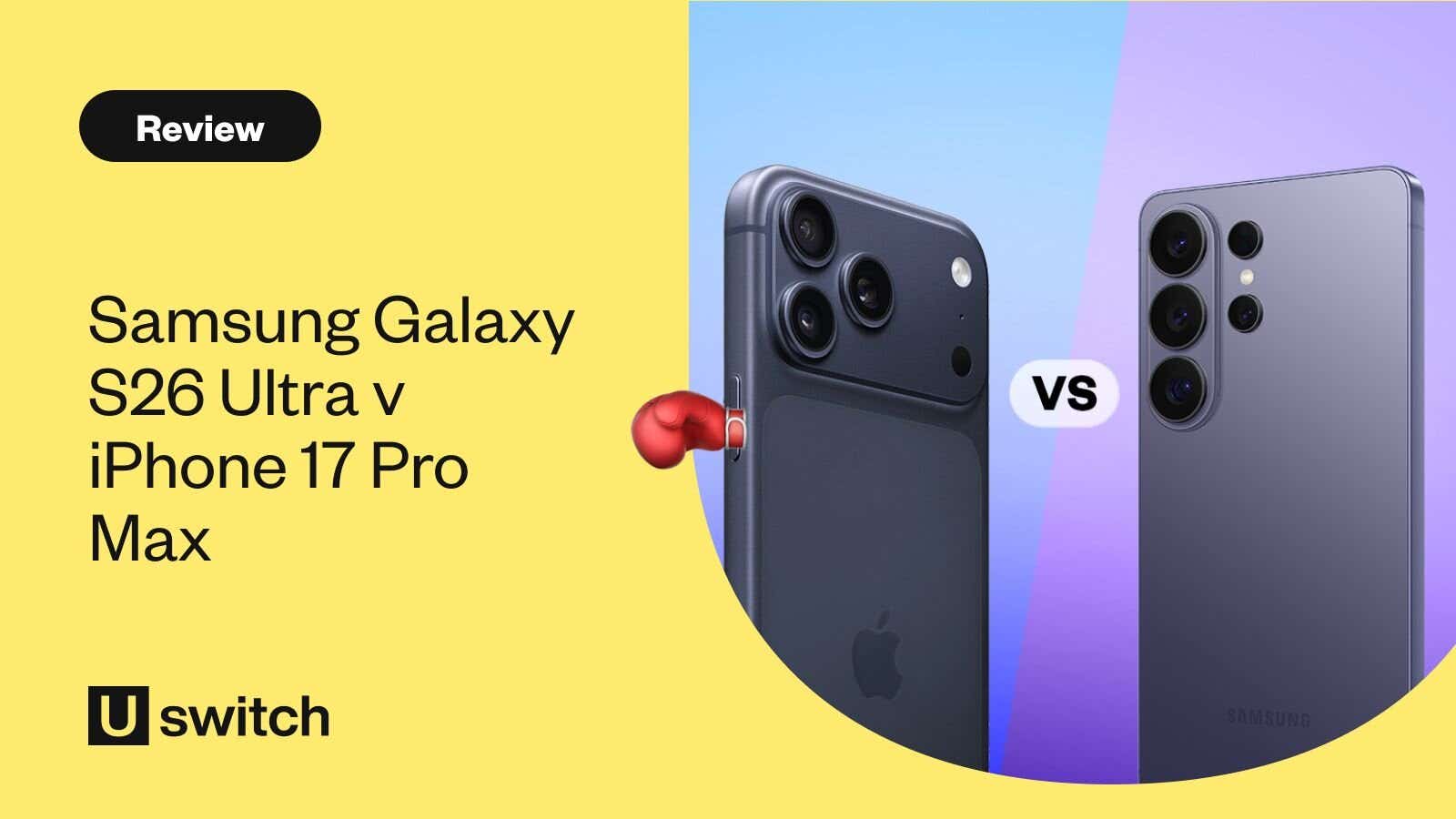
It is the heavyweight title fight of the tech world, and this year, the gloves are truly off. Samsung has arrived with a Privacy Display that has the whole industry talking, while Apple is banking on a refined, AI-heavy experience to keep its crown.
Samsung Galaxy S26 Ultra deals
See our best deals for the brand new Samsung Galaxy S26 Ultra.
The at-a-glance verdict
| Feature | Winner | Why? |
|---|---|---|
| Battery life | iPhone 17 Pro Max | A record-breaking 39 hours of video playback. |
| Innovation | Galaxy S26 Ultra | The "Flex Magic" Privacy Display is a game-changer for commuters. |
| Design | Tie | Both returned to Aluminium; Samsung finally rounded those sharp corners. |
| Best value | iPhone 17 Pro Max | Higher resale value and a slightly lower starting price (£1,199). |
iPhone 17 Pro Max deals
Favour Apple's renowned technology? Compare our best iPhone 17 Pro Max deals now.
For years, the mobile world has been a two-horse race. Whether you’re 'Team Apple' or 'Team Samsung,' the annual release of the iPhone Pro Max and the Galaxy Ultra is the undisputed heavyweight title fight of the tech calendar.
This year, however, the stakes feel different. With the recent launch of the Samsung Galaxy S26 Ultra, we aren't just looking at more megapixels or faster chips. Samsung has introduced a headline-grabbing Privacy Display that has everyone talking. But does it actually beat Apple’s ultra-refined, AI-driven iPhone 17 Pro Max? I’ve spent time with both to see which flagship is truly worth your purchase, comparing everything from their new lightweight aluminium frames to the AI assistants trying to help you run your life.
Design: The return to aluminium
It looks like the tech industry has officially moved past the heavy metal phase of 2024–2025. While titanium was used for the frames of the S24 and S25 and the iPhone 16 Pro Max, the 2026 flagship cycle makes a welcome return to aluminium. This shift hasn't been positioned as cutting costs but about improving everyday comfort, so did I feel the difference?
In short: yes. Both devices retain a premium, high-end feel that justifies their price tags, and thanks to the shift back to aluminium, neither feels prone to overheating during heavy use, particularly while using AI features. However, the iPhone 17 Pro Max just pips the S26 Ultra for pure comfort.

Apple’s contoured frame felt slightly more natural in my palm, whereas the Galaxy’s more angular corners, while improved this year, can still feel a bit sharp during long browsing sessions (albeit a nice reminder to not spend so long on my phone). But if you are someone who spends hours on your phone, that extra bit of smoothness makes a noticeable difference.
It still has to be said that it is great to see Samsung finally addressing the most common complaint from the Ultra's history: the stabby corners. Although not as well done as the iPhone 17 Pro Max, the S26 Ultra features subtly rounded corners that maintain its familiar boxy silhouette while finally sitting nicely in your palms and pockets.
Meanwhile, Apple has focused on internal hardware. To combat the heat generated by its new Apple Intelligence features, the iPhone now includes a dedicated vapour chamber. This keeps the device cool to the touch, even during heavy generative video editing, ensuring the frame doesn't become uncomfortably hot in your hand.
The Pocket test
In the battle of the frames, Samsung has taken a commanding lead in pocketability.
- Samsung Galaxy S26 Ultra: 7.9mm
- iPhone 17 Pro Max: 8.75mm

At just 7.9mm, the S26 Ultra is now noticeably thinner than its main rival. I could really notice the difference when sliding it into my pocket, that near-millimetre difference, combined with the new rounded edges, makes the S26 Ultra feel like a user-friendly device rather than a bulky piece of equipment. It is officially the thinnest Ultra device Samsung has ever produced, proving that you don't need bulk to house a big device.
However, numbers only tell half the story. While Samsung wins on the spec sheet for thinness and ergonomics, for me, the iPhone 17 Pro still takes the crown for design.
Despite the shift back to aluminium, Apple has maintained its signature feel that is instantly recognisable. The new two-tone "Liquid Glass" back and the iconic camera plateau create a well-designed premium aesthetic that carries an undeniable flagship feel.
While the S26 Ultra has made progress to feel more comfortable in hand and pocket, the iPhone remains the winner for those, like me, who prioritise that unmistakable Apple look and the solid design that has become the hallmark of the Pro line.
The AI battle: Siri vs. Now Nudge
Like most tech sectors worldwide, AI is the biggest selling point for both Apple and Samsung in 2026. Having used both the iPhone 17 Pro Max and the Galaxy S26 Ultra over the last few weeks, I am pleased to see we are starting to move past neat AI party tricks that often actually aren’t that helpful in everyday use.
We are now in the era of the AI Agent, where your phone starts to feel like it’s working for you, particularly with organising your weekly routine. Not revolutionary yet, but helpful nonetheless.
Apple Intelligence (iOS 26)

Apple’s approach with Siri in iOS 26 is all about On-Screen Awareness, and in practice, it’s a game-changer for multitasking. Siri is no longer just a search box for your voice; it learns from your habits and makes useful suggestions to help you manage your time more efficiently.
Real-world use: I was recently looking at a flight itinerary that was sent to me in a WhatsApp thread. Instead of copying the flight number, switching to my calendar, and typing it all out, I just asked the phone to "add this to my calendar and text my brother the landing time." Siri read the flight details off the screen, created the event, and sent the text in one go. It feels more like using an assistant on a phone that I can actually trust, whereas previous Siri experiences were nowhere near as smooth.
Samsung Galaxy AI (One UI 8.5)

Samsung has gone down a different route with Now Nudge. While Siri waits for you to ask, Samsung’s AI is constantly trying to stay one step ahead of you. It analyses your habits and uses real-time on-screen data to provide ‘nudges’ before you even realise you need a hand.
Real-world use: I found Now Nudge to be most useful when I least expected it, which is a big compliment. For example, when I opened a blank Friday on my Calendar, Now Nudge subtly popped up a suggestion at the bottom of the screen with a link to book a table at a new restaurant I’d been browsing on the phone a few hours earlier. It’s remarkably good at pulling relevant data, like surfacing a gig ticket from an artist I had been listening to that week on Spotify. It’s a bit eerie at first, but once you get used to it, every other phone feels a bit dumb by comparison.
A19 Pro vs. Snapdragon 8 Elite Gen 5
You don't need to care about the spec sheets to feel the difference the A19 Pro and Snapdragon 8 Elite Gen 5 make. In previous years, AI features often felt like they came with a slight stutter or a kind of buffering spinner.
On these 2026 models, that lag has gone. Whether it’s Siri reading my screen or Now Nudge predicting my next move, the actions are fast and meaningful. The features combine speed and brains to have enough headroom to run complex AI models locally on the device, in a big step forward to make this experience usable for the masses.
Overall, Samsung takes the win in the AI department. The S26 Ultra feels like a truly proactive assistant, constantly analysing your habits to offer help exactly when you need it. By contrast, the iPhone 17 Pro Max still requires a fair amount of hand-holding; while its features are powerful, you have to go looking for them, whereas Samsung brings the solutions directly to you.
Display & privacy
For a number of years now, our phone screens have been getting bigger, brighter and sharper. But that does mean they are far more noticeable, which makes it harder to protect your sensitive information.
It’s a talking point that big phone manufacturers have started to capitalise on, and was one of the main reasons I was particularly excited this year to review the Samsung Galaxy S26 Ultra. Both Apple and Samsung have taken two very different approaches to how we look at and protect our displays.
Samsung’s "Flex Magic": Your screen, your eyes only


The headline feature of the Galaxy S26 Ultra is undoubtedly the Flex Magic Privacy Display. There have been plenty of times that I have been sitting on a crowded bus or a packed train/tube into London, feeling the eyes of the person next to me drifting toward my private messages.
Samsung’s new Flex Magic Pixel technology aims to solve this concern at a hardware level. With a quick toggle in your settings, the screen intelligently limits its viewing angles. To you, looking straight on, the display remains a vibrant, 3,200-nit screen. But to anyone glancing from the side, the screen appears dark and illegible. It’s a brilliant, practical bit of kit for the privacy-conscious commuter that saves you from buying those thick, sticky plastic screen protectors of old.
With all the attention that this new Galaxy Ultra exclusive feature had in the build-up to launch, I really wanted to put this one to the test. I can safely say that it is the first phone feature since the launch of Face ID on iPhone way back in 2017, that I have genuinely been very impressed with.
First thing to say is, it works. As soon as I switched the privacy feature on, I quickly put my friends to work, making them try and peep at what I was doing on the phone from several different angles.
And it passed the test; they genuinely couldn’t see what I was doing. Of course, there were certain angles and lighting that meant you could make out some of what I was up to, but if I was paying for something or replying to a message, I would have complete peace of mind that my sensitive information was protected.
Apple’s clearest display

While Samsung is focused on who else is looking at your screen, Apple is obsessed with making sure you can see it perfectly, no matter the conditions. The iPhone 17 Pro Max counters Samsung's display advancements with the new Ceramic Shield 2.
Apple has introduced a sophisticated anti-reflective coating that makes a massive difference in the glare of direct sunlight (if you are lucky enough to get some in the UK). When you combine this with 3,000 nits of peak brightness, the iPhone 17 Pro Max is arguably the most readable phone Apple has ever made.
Plus, for the accident-prone, Apple claims this new glass is 3x more scratch-resistant than previous models. It’s a screen built to survive being dropped on a pavement and still look good two years into your contract.
When manufacturers make bold claims about durability, I make it a point to do see if that stands up in practical use. So I opted to use the iPhone 17 Pro Max without a case, and frankly, I never felt the need for one. The device feels incredibly robust in the hand; even after a few heart-stopping drops, it held up remarkably well. Most impressively, the screen emerged completely unscathed, a significant departure from the more fragile iPhones of the past.
The verdict on display
- Choose the Galaxy S26 Ultra if you do a lot of banking or messaging in public and value your privacy above all else.
- Choose the iPhone 17 Pro Max if you’re looking for a very durable display that remains perfectly visible even on the brightest summer days.
Battle of the "Pro" cameras
When I took both of these into the wild for a weekend of testing, I moved away from comparing megapixel counts and focused on how the pictures actually turned out and helped me capture the moment.
The iPhone 17 Pro Max really impressed me, given how much worse its camera should be compared to the Ultra on paper. Apple has finally brought consistent 48MP resolution across all three rear lenses, meaning there's no jarring drop in quality when I switch from a wide-angle street shot to a tight portrait. I particularly loved the new 8x optical-quality zoom while catching a sunset one evening.


But for me, the Samsung Galaxy S26 Ultra remains the undisputed go-to for keen photographers. The big change this year is the upgraded f/1.4 aperture on the main lens, which I put to the test while photographing Brighton at night. While the iPhone’s shot was respectable, the Samsung pulled in so much extra light that the final image looked vibrant and sharp. It’s perfect for anyone who spends their time in pubs or at concerts.


And there was the 100x zoom, which I used on the S26 Ultra to capture the same sunset I’d just shot on the iPhone 17 Pro Max, and the level of magnification it achieved was genuinely staggering. While you naturally sacrifice a bit of fine detail at that extreme range, it remains a remarkable feat of engineering. However, it’s in the wider shots where the Ultra truly comes into its own; that massive f/1.4 aperture allows it to drink in far more light than its Apple rival, resulting in a sunset that looked rich and vibrant rather than just good.

The camera verdict: While Apple has made massive strides this year, particularly with adding those 48MP lenses, they are still ultimately playing catch-up.
The iPhone 17 Pro Max is an incredible tool for video and reliable daytime snapshots, but it still feels somewhat behind the Samsung Galaxy S26 Ultra when it comes to raw versatility. Between that insane 100x zoom and the superior light-gathering of the f/1.4 aperture, Samsung remains the top choice for anyone who wants a camera that can truly do it all.
Power, battery & charging
Will my battery last the day is always at the top of any heavy phone user's mind. To find out, I put both through a heavy usage day involving GPS navigation, 5G streaming, and video calls.
The iPhone 17 Pro Max held up very well, and due to its new vapour chamber, it didn’t get that hot during the test. Thanks to the new A19 Pro chip's efficiency, I finished my heaviest day with 34% battery remaining, meaning Apple’s claim of 39 hours of video playback feels fairly accurate in practice. For the average user, this is a genuine two-day phone and provides a level of battery anxiety relief that is hard to find elsewhere.
The S26 Ultra also did really well during testing, proving it could last a few days at a time. However, where the Samsung Galaxy S26 Ultra does take the crown is in the charging department. I’ll admit I forgot to plug it in one night and woke up to a stressful 12% battery.
Thanks to the upgraded 60W Super Fast Charging, I plugged it in, jumped in the shower, grabbed a coffee, and 30 minutes later, I was back at 75%. In comparison, the iPhone’s 40W charging feels a little pedestrian, taking about 20 minutes just to hit the halfway mark. It’s also worth noting that both now support the Qi2 wireless standard, so I was able to use the same magnetic snap-on chargers for both devices, which is a massive convenience win.
The power verdict: My personal pick is the iPhone 17 Pro Max. While I love Samsung’s charging speed, the peace of mind offered by the iPhone’s massive battery life is more valuable to me during a busy work week.
Which flagship deserves your cash?

After a month of switching between these two top-tier phones, it’s clear that the gap between Apple and Samsung has never been smaller. If you choose the Samsung Galaxy S26 Ultra, you are getting a glimpse into the future of mobile hardware.
Its Privacy Display is a genuine innovation for the modern commuter, and the sheer versatility of its 100x zoom and low-light Nightography is still a step ahead of what Apple offers. It is a power user’s dream that rewards those who want to dive deep into every setting and AI feature.
However, if I had to put my own money down on a new phone today, I would choose the iPhone 17 Pro Max. While Samsung might win on raw specs, the iPhone wins on everyday use (aided by the fact that I have been in the Apple ecosystem for years).
The return to a lightweight aluminium frame makes it remarkably comfortable to hold, and the peace of mind it offers with its staggering two-day battery life is something I found myself valuing more than any flashy AI trick. It feels like a device that was built to last, both physically, with that impressively tough new screen. It’s the ultimate all-rounder that does everything at a consistently high level.
Final scorecard - iPhone 17 Pro Max: 9.5/10
The good
Unbeatable battery life
Incredibly robust design
The most consistent camera system for video.
The bad
Charging speeds still lag behind Samsung
The design is safe rather than revolutionary.
Final scorecard - Samsung Galaxy S26 Ultra: 9/10
The good
The Privacy Display is a game-changer
100x zoom is still insane
Charging is much faster
The bad
AI can occasionally feel too intrusive compared to Apple’s more subtle approach
Higher upfront cost.
